
Building Healthcare Security Programs Around Prevention, Partnership, and Patient Care

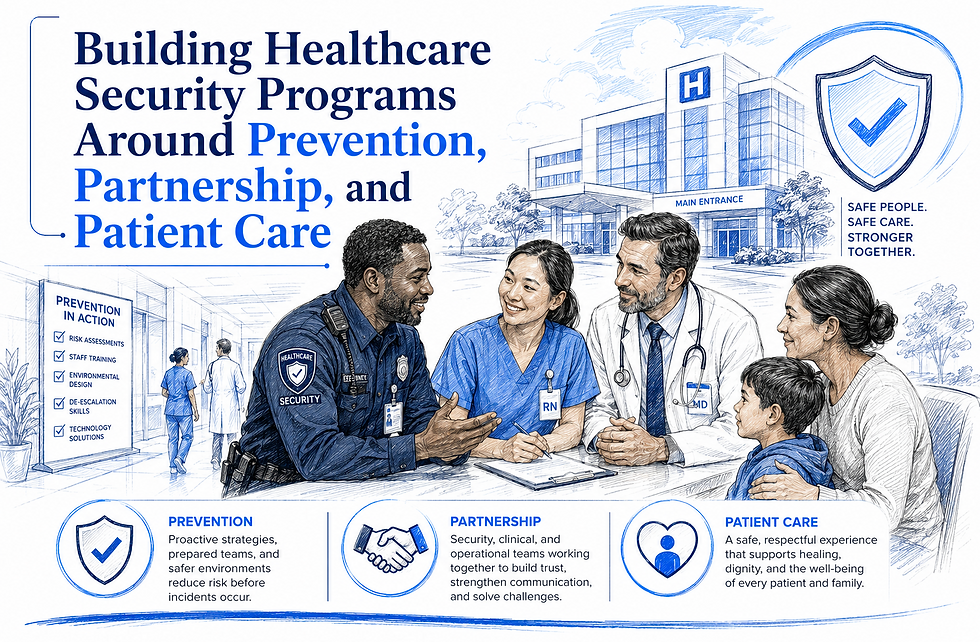
Security programs are often judged by how well they respond when something goes wrong. Response matters and hospitals must be ready to manage violence, threats, access control concerns, emergency codes, investigations, visitor issues, disruptive behavior, and requests for staff assistance.
But the most effective programs are also built around what happens before the call is made. Before a call is needed.
In healthcare, public safety is not separate from patient care. It protects the environment so patient care can happen. This distinction matters because hospitals are complex emotional environments. Patients and families may arrive in pain, fear, grief, confusion, intoxication, frustration, crisis, or loss of control. Staff move between clinical priorities, documentation demands, staffing pressure, family concerns, and escalating behavior.
In that environment, a program built only around response will arrive late to some of the most important moments.
Workplace violence remains one of the clearest reasons healthcare security must be viewed through a prevention lens. OSHA has long identified healthcare and social service workers as facing significant workplace violence risk and recommends comprehensive prevention programs that include management commitment, worker participation, worksite analysis, hazard prevention and control, training, and recordkeeping or program evaluation.
The Joint Commission has also emphasized workplace violence prevention through leadership oversight, policies and procedures, reporting systems, data collection and analysis, post-incident strategies, training, and education.
But why? Let’s look at the most recent data available from the Bureau of Labor Statistics.
In the 2023–2024 BLS Survey of Occupational Injuries and Illnesses, private industry recorded 77,780 DART (Days Away, Restricted, or Transferred) cases caused by violent acts by another person.
Health care and social assistance accounted for 55,920 of those cases, or nearly 72% of the private-industry total.
Hospitals accounted for 22,630 DART cases, or 29.1% of all private-industry DART cases caused by violent acts by another person.
General medical and surgical hospitals, a subset of hospitals, accounted for 17,250 cases, or 22.2% of the private-industry total.
In the same time frame, health care and social assistance accounted for 37,720 private-industry days-away-from-work cases caused by violent acts by another person, representing nearly 70% of all such private-industry cases.
Nonfatal comparison: BLS 2023–2024
Measure: DART cases due to violent acts by other person
Coverage: Private industry
Period: 2023–2024 combined
Industry | DART cases from violent acts by other person | Share of all private-industry DART cases |
All private industry | 77,780 | 100% |
Health care and social assistance | 55,920 | 71.9% |
Hospitals | 22,630 | 29.1% |
General medical and surgical hospitals | 17,250 | 22.2% |
Educational services | 5,490 | 7.1% |
Retail trade | 4,540 | 5.8% |
Accommodation and food services | 2,760 | 3.5% |
Transportation and warehousing | 1,680 | 2.2% |
Manufacturing | 560 | 0.7% |
Construction | 400 | 0.5% |
One last data point. While it is not the largest in all industries, this number is significant. Fatalities due to violence in the healthcare sector may not be the highest, but the percentages are alarming. In 2024, BLS CFOI data reported 20 fatal occupational injuries in hospitals, including 11 categorized as violent acts. While healthcare does not account for the largest share of workplace violence fatalities across all industries, this proportion shows that violence remains a significant fatality concern within hospital settings.
Category | Total fatal occupational injuries, 2024 | Fatalities due to violent acts, 2024 |
All industries, all ownerships | 5,070 | 733 |
Private industry | 4,616 | 595 |
Health care and social assistance | 120 | 36 |
Hospitals | 20 | 11 |
General medical and surgical hospitals | 19 | 11 |
This article presents a practical framework for building healthcare security programs around prevention, partnership, and patient care. It does not suggest that security officers become clinicians. Rather, it argues that officers and security leaders must understand the healthcare environment in which they work and be integrated into the systems that identify, communicate, and reduce risk before harm occurs.
Why Prevention Matters in Healthcare Security
Calls for assistance, investigations, patrols, access control, emergency codes, and incident reports are necessary. Officers must be trained, equipped, supported, and ready to respond. Cameras, radios, panic alarms, visitor management systems, weapons screening, reporting platforms, and duress systems all have a place.
Yet healthcare violence prevention does not begin when support is called to a room. It begins when staff recognize that behavior is changing, a visitor’s frustration is building, a patient’s agitation is escalating, a co-worker is becoming aggressive, or a process is beginning to break down.
Early warning signs often appear before threats or violence. A person may become louder, more rigid, more intrusive, more demanding, or focused on a perceived injustice. They may pace, refuse direction, challenge boundaries, repeatedly approach staff, or position themselves in ways that make staff feel unsafe. These are not always security events yet, but they are safety information.
The question is whether the organization has created a culture where that information moves early.
If staff wait until behavior becomes unmanageable before asking for support, the response starts from a disadvantage. If help is called only after the room has boiled over, they inherit the emotion, delay, frustration, and risk. Calling for help early should not be viewed as overreacting. It should be viewed as using the team.
A prevention-centered program normalizes early support. It teaches staff to recognize warning signs, communicate concerns, document behavior clearly, and involve others before the only remaining option is intervention.
Case Example: The Late Call
In one hospital setting, staff attempted to manage an increasingly agitated visitor without calling for support because they did not want to “make it a security issue.” The visitor had repeatedly approached staff, challenged the information provided, raised his voice, and moved closer to the nurses’ station. Security was eventually called only after the visitor blocked staff movement and refused direction.
By the time officers arrived, the situation was already framed as confrontation. Staff were frustrated, the visitor felt cornered, and the officer entered a room full of accumulated emotion. A review afterward showed that several early warning signs had been present well before the call. The lesson was not that staff had failed. The lesson was that the system had not normalized calling early.
Security as Part of the Care Environment
Healthcare security officers work where clinical care, human vulnerability, and operational pressure overlap. Their actions can influence whether a situation stabilizes or escalates.
This is why healthcare-specific training matters.
An officer entering an emergency department treatment room, behavioral health area, maternity unit, ICU waiting room, registration area, or inpatient unit is entering a human stress moment. Tone, posture, timing, facial expression, distance, word choice, and positioning all matter.
An officer who understands healthcare knows how to enter without taking over unnecessarily. They know how to support staff without making the patient or visitor feel surrounded. They know when presence is enough, when boundaries must be set, when clinical leadership should remain the lead voice, and when the safest action is to step back and bring in additional resources.
Healthcare security training should include more than generic security response.
Officers need instruction and coaching in healthcare-specific conditions, including:
Patient rights, privacy, and dignity
Trauma-informed communication
Behavioral health dynamics
Substance use and intoxication
Dementia, delirium, and confusion
Grief responses and family stress
Clinical decision-making and care team roles
Visitor management and access expectations
Use of force and restraint support
Documentation
Law enforcement coordination
De-escalation and non-escalation practices
Most importantly, the officer’s role is not simply to “handle” people. The role is to help maintain a safe environment where care can continue.
When officers are treated as part of the care environment, they are included earlier, briefed better, and trusted more by staff. Visibility becomes preventive. Relationships become operational. Presence becomes part of the safety system.
On the flip side, clinical staff should also be trained in these items and understand the role of support when support is called. While physical intervention may become necessary, it should never be the norm, or the expectation when support is called.
Case Example: Presence Without Taking Over
A charge nurse noticed that a family member was repeatedly approaching staff about delays in care. The person was not threatening, but frustration was rising. Instead of waiting for the behavior to become disruptive, the charge nurse contacted security and asked for a nearby presence during the next update.
The officer did not enter abruptly or lead the conversation. The clinical leader provided the update while the officer remained calmly present in the area, in sight, but not in the conversation. The family member saw that expectations were consistent, staff felt supported, and the situation stabilized without enforcement action. The prevention value came not from force, but from timing, coordination, and calm presence.
Prevention Does Not Belong to Security Alone
One common weakness in workplace violence prevention is the quiet belief that violence prevention is the security department’s responsibility.
Security has a critical role, but security cannot own prevention alone.
A safer hospital requires staff across the organization to understand their part. Nurses, physicians, registration staff, social workers, technicians, transporters, environmental services staff, unit clerks, leaders, and others all encounter early warning signs. Each group also influences the environment through communication, clarity, boundaries, expectations, and follow-through.
This does not mean every employee becomes a security officer. It means every employee understands how their role connects to safety.
Staff should know how to explain delays, give clear next steps, set respectful limits, call for support when behavior begins to shift, and document threatening or disruptive behavior. They should also know they are not expected to tolerate abuse or manage escalating behavior alone.
Training should make this practical. Employees need clear examples:
What to say when a visitor refuses to leave
How to respond when someone begins yelling
When to step away
Who to notify
What information to provide when calling for help
How to document threatening behavior
How leaders will support staff who report concerns
The strongest prevention programs create shared language. “Call early” should not mean “call security for every difficult conversation.” It should mean staff are expected to involve the right resources before a situation becomes unsafe.
Table. Response-Centered vs. Prevention-Centered Healthcare Security
Response-Centered Program | Prevention-Centered Program |
Security is called after behavior escalates | Security is included when warning signs appear |
Tracks calls for service | Tracks early interventions, repeat locations, and risk patterns |
Officers are viewed mainly as responders | Officers are viewed as part of the care environment |
Training focuses primarily on intervention | Training includes presence, communication, boundaries, observation, documentation, and healthcare-specific risks |
Reviews serious events after harm | Reviews patterns, near misses, and process issues before harm occurs |
Staff may delay calling to avoid “making it a security issue” | Staff are taught that early support is part of team-based safety |
Success is measured by response volume and incident closure | Success is measured by prevention, staff confidence, reporting, reduced harm, and system learning |
Table. Early Warning Signs and Suggested Team Actions
Early Warning Sign | Suggested Team Action |
Repeated approaches to staff | Assign one point of contact, clarify next steps, and notify charge nurse or leader |
Raised voice, pacing, clenched posture, or visible agitation | Create space, reduce the audience, speak calmly, and call for support early |
Refusal to follow visitor limits or direction | Restate expectations respectfully and involve leadership or security before confrontation develops |
Fixation on perceived unfairness or delay | Acknowledge the concern, explain the process, provide realistic updates, and document behavior |
Staff feel trapped, unsafe, or unable to disengage | Step away if possible, call early, and use a team response |
Threats, intimidation, or blocking movement | Treat as a safety event, notify security immediately, protect exit paths, and document clearly |
Culture Is Built Before the Incident
Healthcare organizations often review workplace violence after harm occurs. Those reviews matter. But culture is built before the incident.
Culture is built when leaders respond seriously to staff concerns, when reports lead to action, when officers are invited into safety huddles and planning meetings, and when disruptive or threatening behavior is not minimized as “part of the job.”
If staff are told to report threats but nothing happens, reporting fades. If officers are told they are part of the team but are excluded from communication, partnership weakens. If workplace violence prevention is discussed only after serious events, it becomes a reaction rather than a practice.
A prevention-centered program needs feedback loops. Staff should hear what was done with the information they reported. Officers should be included in after-action reviews. Leaders should look for patterns, not just individual incidents.
Helpful review questions include:
Where are repeat calls occurring?
Are calls coming early or late?
What behaviors are being reported?
Are staff documenting threats, intimidation, and disruptive conduct?
Are visitor expectations clear and consistently applied?
Are delays or process failures contributing to escalation?
Are officers receiving enough information before entering a situation?
Are corrective actions tracked to completion?
Are staff hearing back after reports are made?
These questions move the program from response to prevention.
Case Example: Finding the Pattern
A facility reviewed several incidents from the same waiting area over a short period. At first glance, each incident appeared to involve a difficult visitor or frustrated patient. A deeper review showed common contributing factors: unclear communication about delays, inconsistent visitor expectations, limited visible rounding, and delayed calls for support.
The solution was not simply “more security.” The team improved communication about wait times, clarified visitor expectations, increased leader rounding during peak periods, and created clearer triggers for early security notification. Security remained part of the solution, but the risk was reduced through process improvement, communication, and shared ownership.
The Cost of Waiting Until Response
Prevention is often discussed as a safety priority, but it is also a financial and workforce priority.
Workplace violence, intimidation, and repeated disruptive behavior affect staffing, retention, morale, patient experience, workers’ compensation, overtime, recruitment, and leadership credibility. These consequences matter in an already strained healthcare workforce.
National data continue to show the burden of injury and violence in healthcare and social assistance. The Bureau of Labor Statistics reported 562,500 recordable injuries and illnesses in private industry healthcare and social assistance in 2023. NIOSH has reported that healthcare and social assistance workers face the greatest risk for nonfatal workplace violence involving days away from work. Peer-reviewed literature also connects workplace violence against healthcare workers to physical and mental health impacts, reduced worker resources, and potential impacts on quality and access to care.
This is especially important in nursing. Estimates vary by source and methodology, but early-tenure nurse turnover remains a serious concern. Some research and workforce reports have described first-year or early-tenure nurse turnover in ranges that should concern healthcare leaders. A Press Ganey “State of Nursing 2026” report (May 11, 2026) stated one-in-five new nurses quit within the first year. Even when the exact number varies, the lesson is consistent: hospitals cannot recruit their way out of environments people do not feel safe staying in.
A prevention-centered public safety program should not be viewed only as a cost center. It is part of the organization’s retention strategy, risk strategy, and care environment strategy. When officers are integrated into the care environment, staff are trained to recognize early warning signs, leaders support reporting, and help arrives before escalation becomes violence, the organization is investing upstream.
The return is not only fewer serious incidents. It may include fewer injuries, fewer lost workdays, stronger reporting, improved staff confidence, better visitor management, more consistent response, and a workplace where employees believe the organization sees their safety as part of patient care.
Hospitals spend significant money recruiting, onboarding, orienting, and replacing staff. Some of that investment is unavoidable. But when turnover is driven by preventable environmental and cultural conditions, the better question is not “Can we afford to invest in prevention?” It is “How much are we already spending because we have not?”
Building the Program
Healthcare security leaders can strengthen prevention and partnership by focusing on practical areas.
First, define the security department’s role in the care environment. Staff should understand what security does, when to call, what information to provide, and how security supports care teams. Officers should understand when they are supporting clinical leadership, when they are setting boundaries, and when intervention or law enforcement coordination may be required.
Second, train officers for healthcare-specific conditions. This should include communication, boundaries, observation, trauma-informed principles, behavioral health considerations, use of force, restraint support, documentation, and coordination with clinical and law enforcement partners.
Third, train hospital staff on recognizing warning signs and calling early. Staff should not be left to guess whether a situation is “bad enough” to ask for support. Training should include scenarios, words to use, escalation triggers, reporting expectations, and leader support.
Fourth, integrate officers into safety huddles, rounding, drills, risk discussions, workplace violence prevention committees, and after-action reviews. Security cannot be expected to prevent risk if it is only invited after risk becomes an incident.
Fifth, measure more than response volume. Calls for service matter, but they are only part of the picture. Prevention-centered programs should also track early interventions, repeat locations, behavior types, staff injuries, response times, reporting patterns, corrective actions, visitor-related incidents, and post-incident support.
Finally, build trust. Staff must trust that support will come. Officers must trust that leaders understand their role. Patients and visitors must see consistent expectations. Leaders must treat safety as a shared operating condition, not a department-specific task.
Practical Implementation Checklist
Healthcare security leaders can begin by asking:
Is the role of security in the care environment clearly defined?
Are officers trained for healthcare-specific situations?
Are staff trained to recognize early warning signs?
Do staff know when and how to call security early?
Are officers included in huddles, drills, risk reviews, and after-action discussions?
Are disruptive, threatening, or intimidating behaviors documented consistently?
Does reporting lead to visible action or feedback?
Are repeat locations and patterns reviewed?
Are corrective actions assigned and tracked?
Are leaders reinforcing that staff are not expected to tolerate abuse as part of the job?
Suggested Measures for a Prevention-Centered Program
A prevention-centered healthcare security program may track:
Calls for service by location, time, and type
Early interventions before violence occurs
Repeat patients, visitors, or locations creating safety concerns
Staff injuries related to workplace violence
Threats, intimidation, and disruptive behavior reports
Response times
Use-of-force or restraint-support incidents
Visitor restriction or management actions
Staff perception of safety
Follow-up after reports
Corrective actions completed
Lessons learned from after-action reviews
Industry Resources for Readers
Healthcare security leaders do not need to build these programs from scratch. Several industry resources can support prevention-centered program development:
OSHA’s workplace violence prevention guidance for healthcare and social service workers provides a framework for management commitment, worker participation, worksite analysis, hazard prevention and control, training, and program evaluation.
The Joint Commission’s workplace violence prevention standards and resources emphasize leadership oversight, policies and procedures, reporting, data collection and analysis, post-incident strategies, training, and education.
NIOSH resources on workplace violence and healthcare worker safety provide research and prevention information.
IAHSS industry guidelines and publications offer healthcare security-specific guidance that can help security leaders align operations with healthcare risk, accreditation expectations, and professional practice.
Internal data sources such as incident reports, workers’ compensation claims, employee injury data, patient experience feedback, security calls for service, and staff safety surveys can help organizations identify local risk patterns.
The best use of these resources is not to create a binder that waits for survey season. The value comes from turning guidance into daily practice: training, huddles, rounding, reporting, review, feedback, and leadership follow-through.
Conclusion
The strongest healthcare security programs do more than respond to unsafe moments. They help create conditions where safer care can happen.
That requires prevention, partnership, and patient care to be connected. It requires officers trained for the healthcare environment, staff who understand their role in workplace violence prevention, and leaders who support early action, reporting, learning, and follow-through.
Healthcare security will always need response capability. Hospitals need trained officers, reliable systems, clear procedures, and the ability to intervene when safety is threatened. But if the program is built only for urgent intervention, it will miss the quieter opportunities to prevent harm.
A strong healthcare public safety department is not separate from patient care. It protects the environment where patient care happens.
References and Suggested Reading List
American Hospital Association. The Burden of Violence to U.S. Hospitals. 2025.
American Organization for Nursing Leadership. Early-Tenure Nurse Retention: Trends and Leader Strategies. 2025.
Bureau of Labor Statistics. Fatal and Non-Fatal Occupational Injuries for Selected Occupations, 2020-2024.
International Association for Healthcare Security and Safety. Healthcare Security Industry Guidelines. Current edition.
Joint Commission. Preventing Workplace Violence. Workplace Violence Prevention Resources and Standards. National Performance Goals Chapter, Section 3, June 2026.
National Institute for Occupational Safety and Health. Workplace Violence Prevention and Healthcare Worker Safety Resources.
Occupational Safety and Health Administration. Guidelines for Preventing Workplace Violence for Healthcare and Social Service Workers. OSHA Publication 3148. 2016.
O’Brien CJ, et al. The Growing Burden of Workplace Violence Against Healthcare Workers: Trends, Consequences, and Preventive Strategies. 2024.
Press Ganey “State of Nursing” report, May 2026
Lay KSM, et al. Turnover Prevalence and the Relationship Between Transition Experiences and Intent to Stay Among Newly Licensed Registered Nurses. 2025.
Dunning, M. W. The Hello Doctrine: Healthcare Security and the Practice of Prevention. Kindle Publishing, 2024


Comments